verbing the adjective noun since 1902

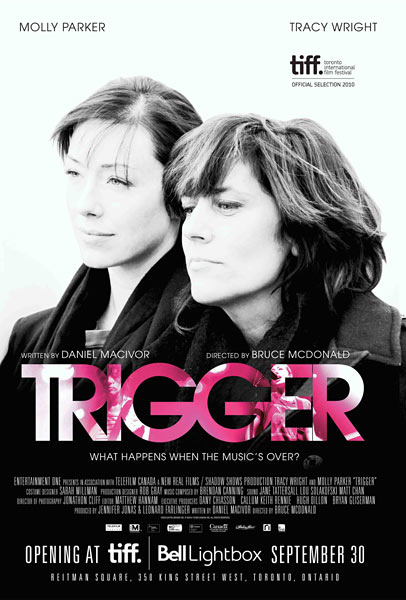
Vic (Tracy Wright) and Kat (Molly Parker) grew up together. They started a band together. They lived their lives together. They abused themselves with drugs and narcotics together. They were Trigger together.

Trigger is playing/was playing a short engagement at Toronto’s brand-spankin’-new TIFF Bell Lightbox, and director Bruce McDonald was on-hand to introduce the film to the audience.

McDonald explained that the film started as a continuation of the story of Joe Dick and Billy Talent who were the two front-men of the fictional band Hard Core Logo. Unfortunately Hugh Dylan’s and Callum Keith Rennie’s schedules made it impossible. Rather than scrapping the screenplay, McDonald and writer Daniel Macivor rewrote the film about a new band, a riotgrrl band called Trigger.

Though it’s not actually titled “Hard Core Logo 2,” the film feels it, and it’s easy to see Vic as Joe Dick and Kat as Billy Talent. Rennie even makes a brief appearance as “Billy” and the audience is left to assume that this is Billy Talent, while Julian Richings makes a brief appearance as his Hard Core Logo role Bucky Haight.

How does it differ?

Hard Core Logo is about a band coming together for a sham-benefit while one member has a greater goal. Trigger is about a band coming together for a sham-benefit while one member has a greater goal.

Hard Core Logo is about men who are still children. Once the band broke up, they stopped evolving, and their lives were static. When they reunited, all the love and all the hatred were still at the forefront.

Trigger is about a band who grew up. They’ve become better women and grown, and learned from their mistakes. They’re still making mistakes, and are unsure of where to lead their lives, but they’re better people than they once were.

That’s the major difference. Trigger isn’t rehashing what was done before. Trigger is telling a different story within an existing universe.

One interesting thing about this film is how old everyone looks. Parker, Wright, Rennie, and McKellar all look like they’ve lived lives of abuse and are falling apart. It fits perfectly with the context of the film, and creates a realism, which was only disturbed by a guitar strap continuity error.

Definitely worth seeing. You don’t need to have seen it’s predecessor to enjoy the film, but it wouldn’t hurt. Most importantly, it’s a great farewell to a wonderful actor who the Toronto scene has recently lost, Tracy Wright.

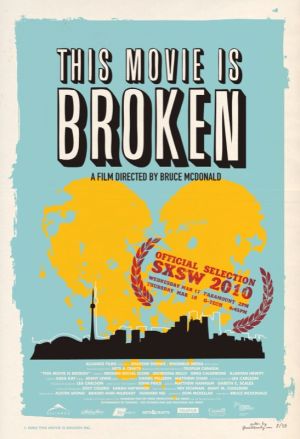
Bruce McDonald reinvented the concert film. Instead of shooting performers on a stage, McDonald attempted to tell a story in the context of a concert. This Movie Is Broken follows a young Toronto man and the love of his life, who’s recently returned to Ontario. Their paths lead them to Harbourfront Centre where Broken Social Scene are playing a free show.

Let’s start off with the obvious (if you know me), I don’t like Broken Social Scene. I don’t hate Broken Social Scene, but I’ve never liked Broken Social Scene. The only member of the band I have any fondness for is Amy Millan, but I don’t like Stars, I just like her first solo record1. I don’t even think Feist is hot, I think she’s funny looking. So why did I go see a Broken Social Scene concert film? It’s directed by Bruce McDonald and written by Don McKellar… duh.

The concert played a bigger role in the film than I had hoped for, but I can’t hold that against it, as it is a BSS concert film. I was very surprised when the first song started and I knew it (mildly), however the rest of the songs were as foreign to me as Graham Nash’s output from the 1980s.

McDonald did an excellent job in capturing the visuals, the film looks good, even though he’s showing Toronto as dingy and dirty. To clarify, the film was shot and takes place on July 11, 2009 when Toronto’s city workers were on strike, and hence garbage was piling up, and city parks became temporary garbage dumps.   

The strike played a major role in the circumstances surrounding the show. Broken Social Scene were scheduled to play their annual concert on the Island, but with municipal workers striking, there was no ferry service. They had to cancel the show, and thus throw a free concert at Harbourfront Centre.

So, I’m not begrudging the film the music, and I like the visuals, what don’t I like? Sorry Don, but it’s gotta be the writing. The story is boring, and underdeveloped, it’s adolescent and to top it all off, the acting is brutal.

If you’re a fan of BSS, see this film in a heartbeat. If you’re a fan of McDonald’s and McKellar’s, ignore it, and wait for Hard Core Logo 2.

  1. I should check out her follow up, one day. []

As a fan of Canadian cinema, I’m by default a fan of Don McKellar’s work. Aren’t we all, after all? McKellar wrote Blindness, a film which I really knew nothing about it before I watched it, other than the author’s previous work. In the film, a Japanese man (Yûsuke Iseya) living in an unknown city finds himself in suddenly blind while sitting in traffic. A man (McKellar) offers to drive him home, after getting him to his destination, he steals the car.

Blindness, while usually described as darkness is instead described as brightness. It slowly spreads from Iseya’s character to the Doctor to McKellar’s character to a prostitute who was in the clinic, etc. etc.

Eventually these characters end up in a prison setting as the Ministry of Health1 decides to quarantine the sick. The film turns into a Lord of the Flies situation as one ward tries to wield power over the others, and control the supply of food.

The story’s a bit cliché, but the cast, and acting, is phenomenal. The cinematography however did win me over. Dark, bleak, desperate; bright, shiny, blinding.

  1. The minister is played by Sandra Oh. []