verbing the adjective noun since 1902
category: Literature
tags:

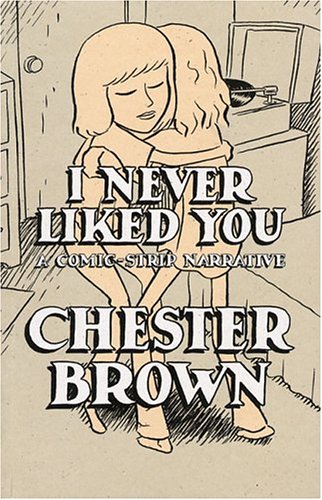
After having read Chester Brown’s fabulous biography of Louis Riel, I thought I should read more of his work. My choices at the Toronto Public Library was limited to his autobiographical I Never Liked You. The book is about growing up in the suburbs, bullied, unsure of yourself and how to approach women.

I read this book on a beach on Toronto Island on a sunny Saturday, and I finished the book too quickly. Brown’s adolescence is dramatized and draws the reader in, as he gets bullied, deals with issues around love, whether familial love or romantic love. Brown faces the horrors of his mother’s mental health issues, and his desire to express his love for his mother.

I didn’t necessarily like the character Chester Brown, but I saw a lot of myself in him, which is probably why I didn’t like him. His story is not about his talents nor is it about his being anything special. It’s a story about an average boy growing up in suburban Montreal., but Brown’s narrative makes you want to know more. He’s good at what he does.

And now we wait until the release of his next book Paying For It, about his involvement in the sex trade industry, as a punter. Or maybe I purchase a copy of The Playboy.

Joey Comeau’s follow up to Overqualified is One Bloody Thing After Another. The previous was the tale of a man’s loss of his brother, as told through cover letters, while One Bloody Thing After Another is a comedy-horror.

Jackie is a teenager in high school. Her mother died, and she’s been haunted since. She wants to ask out her best friend Ann. Ann’s mother is transforming into a beast, and has been refusing food, unless it was still living. Then there’s Charlie, who along with his dog Mitchie are being haunted by a headless ghost who seems to leave a lot of blood in her wake.

While it’s a horror novel, it’s not scary, or maybe I’m just a cold-blooded asshole. It’s funny, and I’m pretty sure it’s meant to be funny. If you’re a fan of Comeau’s and Emily Horne’s webcomic A Softer World, you’d know what type of humour to expect.

Comeau had me laughing out loud, in public, only three pages into the book, in the prologue. Ann’s mother had just left an interview.

“That did not go well,” Jeff says.
He can joke because none of the blood landed on him.

The book is short, at only 165 pages, and its filled with over 50 short chapters. I breezed through the book in a matter of hours, and didn’t want to put it down. All the characters have an interesting history, getting the reader directly connected immediately, and the humour will surprise you.

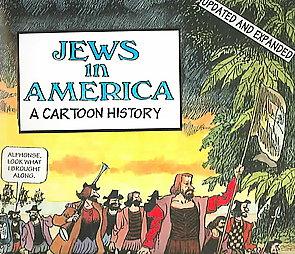
I was at the Pape/Danforth Library, browsing the graphic novel section for any works by Chester Brown1, I didn’t find any, but I did find this book, Jews In America. As a Jew in (North) America, I figured much of my people’s history will be in here. Sure I knew not to expect stories of riots in Christie Pits, or the tales of Montreal Jews, but I knew there would be some connections.

Well, the author, David Gantz, unfortunately doesn’t really tell much of a story. His book is so disjointed that he doesn’t get across any interesting stories, he just briefly glosses over the horrors and success that Jews found in America. It was interesting to find out that some of the crew aboard Columbus’ first voyage to the American continents were Jewish, but his explanation of their need to leave Spain was simply, “It was the inquisition, they had to leave.” While any adult Jew knows of the horrors of Inquisition, I’m sure that many grade eight students don’t quite know the extent of the drama those Sephardic Jews faced.

History in comic form is an excellent educational tool for middle school aged students who are learning about their history. This isn’t a good example of that.

The art isn’t even anything to show interest, either. I’m unsure if he’s drawing caricatures or attempting realism, Gantz has got no solid style throughout the book that really comes across to the reader to connect the stories.

I’m also slightly annoyed with his coverage of the Suez Crisis, with nary a mention of Lester B. Pearson, a man who I think to be one of history’s greatest, who won a Nobel Peace Prize for saving the world.

  1. After really enjoying his book on Louis Riel. []

I’ve been wanting to read this book since I first found out it had been written, which was quite some time ago. I had been meaning to borrow it from my employer’s library, but never got around to it. Then I saw it in my sister’s old bedroom1 on her bookshelf. I borrowed it and read it in two days.

You might be wondering “who is Louis Riel” and why should I care about him. So let’s get some facts.

    Basic info

    Louis Riel was a Métis, educated in Montréal, who returned to his home, the Red River settlement in what was then known as Rupert’s Land.

    • The Métis are part-French, part-First Nations.
    • Red River settlement is now known as Winnipeg.
    • Rupert’s Land was owned by fur traders, the Hudson’s Bay Company, which is now a department store known as The Bay, or HBC.
    • Rupert’s Land consisted of much of what is now The Northwest Territories, Nunavut, Ontario, Quebec, Manitoba, Saskatchewan, and Alberta.

    Very short bio of Louis Riel

    • A hero to the French, and villain to the English.
    • Led two rebellions against the Government of Canada.
    • Founding father of Manitoba.
    • Elected twice to the House of Commons, never sat.
    • Was exiled from Canada, and lived in the United States.
    • Believed the Métis to be the thirteenth tribe of Israel.
    • Was fuckin’ insane.
    • Tried, convicted, and hanged for treason.
    • His life is taught in every grade eight classroom from coast to coast.
    • The only exciting part of Canadian history.
    • Was ranked the 11th greatest Canadian by the CBC’s Greatest Canadian program.

    More history

    In 1870, the young Canadian government, headed by Sir John A. Macdonald purchased the land from the Hudson’s Bay Company. Their plans were to eventually give that area proper representation, but a fear of a double threat from the French2 led Macdonald to hold off on bringing democracy to what would be Manitoba, until Eastern Anglos could move out west and bring along the loyalty to the crown. And that was the tip iceberg.

    The Métis weren’t opposed to joining Canada, they just wanted their say, and proper representation in Canada. This led to a rebellion, and the Métis were given their demands, the Manitoba Act was passed3, and the provisional government (headed by Riel) were given amnesty, except for Riel, who had a lynch mob after him. Riel fled to the United States.

    Once he returned to Canada, Riel ran for a seat in the Commons, and won it easily. With a price on his head, he was never able to take his seat in Parliament.

    Métis, Cree, and Blackfoot, living in what is now Saskatchewan were starving, as the Buffalo were falling extinct. These First Nations were learning agriculture and finding themselves in the same land claim problems the Manitoban Métis had a few years earlier. They asked for assistance from Riel. Long story not much longer, they rebelled, many died, they got much of what they wanted, the government got what they wanted (Riel).

    Riel was then tried, convicted, and hanged for High Treason.

    Comic Books

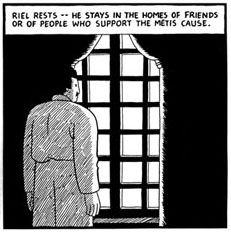
    So what does that all have to do with a comic book? Well Louis Riel is the story of Riel’s life as told in the form of a comic strip. First off, we know that Brown has a limited audience because only Canadian would be interested in this story which is a unique story among all of Canadian history. More importantly, though Riel’s story is exciting and filled with bloodshed, it’s also boring and technical, with details about the seigneurial system, French/English bickering, and Macdonald’s political aspirations.

    Riel’s story is not an easy one to study, but I think Chester Brown’s book would be a great help from young students learning about this important part of Canadian history. More so, Louis Riel is a great graphic novel. If we ignore the simple fact of its historical context, and just focus on it as a story, it’s captivating, entertaining, and extremely enjoyable.

    Chester Brown’s art is simple, but it provides a great visual which helps narrate Riel’s story.

    I’d recommend this book to anyone, Canadian or foreign who wants to read an interesting story about racism, fighting for freedom, and mental health.

    1. Why is Shira’s bedroom exactly as she left it, and mine in no way resembles what I left behind? []
    2. Quebec and franco-Manitoba []
    3. As such, Manitoba entered Confederation. []

    When I heard that Edgar Wright was directing a film based on the Scott Pilgrim series of graphic novels, I was stoked. I wouldn’t let the cynicism of a certain Pilgrim fan-girl bring me down, and I’d hope for the best.

    I was wrong. I was completely and totally wrong. I expected this film to be amazing, and it went well above and beyond any expectations I had.

    The Story

    A young man named Scott Pilgrim meets a foreign girl named Ramona Flowers who recently moved to his city, he falls for her, but to win her, he must defeat her seven evil-exes.

    That’s pretty much the story in a few seconds. It’s not that complicated, but what is important is who these characters are. There’s Scott Pilgrim, a man who’s lived in Toronto his whole life1. He’s a slacker, who’s between jobs, his ex-girlfriend, Envy Adams, is now a Lady Gagaesque superstar who broke his heart. He’s recently rebounded, after 400 days, with a high school girl named Knives Chau, but shortly thereafter falls for the new girl, Ramona.

    Knives is in many ways perfect for Scott, if he were actually a good person, but instead he’s much too horrible for her.

    Scott’s in a band called Sex Bob-omb with Stephen Stills2, and his ex-girlfriend Kim Pine. They have a fan… one fan. His name is Young Neil.

    Then there’s Ramona. She moved from the United States to Canada, to get away from the life she was living. Unfortunately that life and her evil-exes followed her to Toronto.

    Gideon wants Ramona for himself, and with the help of the six other evil-exes, he’ll do anything to have his trophy woman.

    The Cast

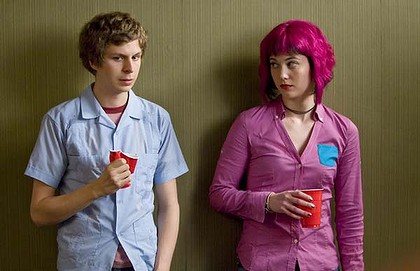
    Many people balked at Michael Cera’s casting this film. I cannot say I’m a fan. I don’t like Arrested Development, and pretty consistently he plays the exact same character. Youth In Revolt, was a film that he showed he was more than just the sad hipster loser (with a hot girl on his arm). Cera played an asshole in Youth In Revolt, and while the film wasn’t great (see my review), Cera proved himself as worth as playing Pilgrim. Obviously Edgar Wright agreed, and Pilgrim was perfectly cast.

    Seeing Kieran Culkin’s small bits in the trailer as Wallace, Scott’s gay roommate, had me worried, I wasn’t thrilled with what I saw, but once I had the full context of the film, I think he might have stolen the movie. Wallace was everything Scott needs, whether it be a kick in the balls or the mothering of this slacker do-nothing. Wallace was hilarious and much I believe is Culkin.

    Ellen Wong was Knives Chau. They couldn’t have picked a better actress to take that role, and she embodied the character so well.

    I had no idea who Aubrey Plaza was, but I know she looked so familiar. She was hilarious, in her cold-asshole manner. She’s the perfect woman to put Pilgrim in his place.

    That leaves us with Mary Elizabeth Winstead who played Ramona Flowers. She might as well have stepped out of the comic book.

    Scott’s An Asshole, But So Is Ramona

    Scott breaks hearts, and so does Ramona. They don’t see the effect they have on the others around them, and live in their own tiny bubble. Scott doesn’t only hurt those he once dated, but even his best friend Wallace. Wallace spends the entire film wanting to kick Scott out of their one-room apartment, but loves the man too much to actually go through with it.

    The Style

    The Scott Pilgrim series of graphic novels are obviously graphic novels. The books are themed like video games, and the film follows this. It steals many elements from comics and video games, and adapts them for the medium. Wright does an excellent job at immersing the viewer into this world of comics and games. Even if you’re not much of a comic lover or game lover, like myself, it creates a great quirky little world.

    Toronto

    There aren’t many films where the audience erupts in cheers, hoots, and hollers a few seconds into the beginning of the film. It did with Scott Pilgrim vs. The World. When the narrator said, “in Toronto, Canada,” the audience erupted. Now, I’m not sure if that has been happening in other cities in Canada, or even other cities elsewhere in the world, but I assume it has been, because Toronto is amazing.

    Torontonians are used to seeing our city on the big screen3. It’s the default stand-in for generic American cities. Though it might be able to be disguised as a generic city, it certainly is not. Toronto has a unique identity and most Torontonians are proud of the city they live in. One of Ramona’s evil-exes is Lucas Lee, an American actor who’s in Toronto filming a generic action film. While they’re shooting outside the beautiful Casa Loma, they’re filming in front of a matte painting of a generic American city. Lee pushes Pilgrim through the painting  to reveal the CN Tower.

    In Scott Pilgrim vs. The World Toronto gets to be itself for a change, and it’s proud of who it is. Whether it be the hideous orange and white decor that is Pizza Pizza, the gaudy lights of Honest Ed’s, the beauty of the Wychwood library, or the iconic Lee’s Palace, Toronto is shown for what it is, and more importantly, it’s the Toronto that is mine. I used to live a few doors down from the Wychwood library, and the Annex is a neighbourhood I find myself in so often, I wonder why I don’t live there… other than the cost. This leads me into the next section…

    Me

    This film seems to be a film made specifically for me. A 20-something music nerd who has a warm place in his heart for classic video games, Toronto, and hot chicks. Scott Pilgrim vs. The World brings all these three things together, along with a lot of awesome music, including Halifax heroes Plumtree, who’s song “Scott Pilgrim” gave the character his name. It really feels as if the film was made for me specifically.

    The Music

    When I heard the soundtrack was going to include Beck as Sex Bob-omb and Broken Social Scene as Crash & The Gang, I was slightly disappointed. I’m not a fan of either. I never liked Broken Social Scene, and I don’t think Beck’s released an album worthy of himself since his okay record Midnight Vultures. Beck’s songs reminded me of his early Mellow Gold days, but with a lot more of his folk that made Mutations brilliant. I was surprised at how good Beck was as Sex Bob-omb.

    Broken Social Scene’s songs as Crash & The Gang were also great. The soundtrack was perfect.

    The Medium is the Message

    Obviously a comic is not a film, and can never be. While Wright tried to stay true to the spirit of the comic, it had to be changed, in many ways. He did an excellent job of compressing a story which spanned six books into a single film, and ended the film in a damn good manner, which addressed the important factors that the novels ending addressed4.

    In Conclusion…

    There is absolutely nothing I would change about this film. Edgar Wright did an incredible job. Best director oscar?

    1. Yes I know it’s not true to the comic, but it’s minor, shut up. []
    2. Not that Stephen Stills. []
    3. My favourite being Short Circuit 2. Since when do they swear in American immigrants in Nathan Phillips Square? []
    4. Scott being an asshole. []

    Scott Pilgrim saw a woman in the Wychwood Library and he fell in love. The woman was Ramona Flowers, an American who had recently moved to Toronto. She was working for Amazon, as a delivery girl, and Scott used this knowledge to get her to him, and get her to go out with him. Shortly after their relationship starts, Scott learns he must defeat her seven evil exes if he wants to keep her. Books one through five chronicle his journey in defeating the first six of her evil-exes1

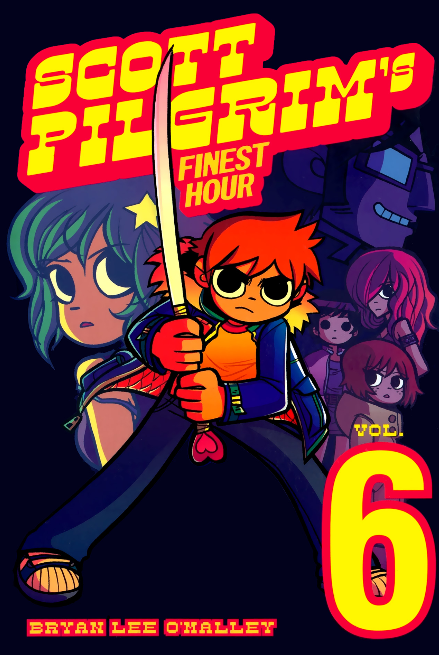
    In Scott Pilgrim’s Finest Hour, Pilgrim faces the final evil ex, Gideon.

    For those who are unfamiliar with the series, it’s basically an old-school video game which is not grounded in the real world. The only thing remotely realistic about this is how well and accurate O’Malley draws and represents Toronto.

    Scot is an asshole. He’s been an asshole to all the previous women in his life; he’s been an asshole to Wallace, his roommate and best friend; he’s been an asshole to his band, Sex Bob-omb; and he’s even been an asshole to his girlfriend Ramona. Yet we still like the character, I have no idea why, because he doesn’t deserve any compassion, but O’Malley does a great job of making Pilgrim’s personality something we can overlook.

    Spoilers ahoy.

    In this final book, we learn that Ramona is an asshole, too. Sigh. That’s good, however, because when Scott and Ramona end up together at the end of the book, we can be happy that they’ve both grown and learned from their pasts, and that they deserve one another.

    O’Malley did a rather good job of wrapping up the Pilgrim storyline. The main characters all resolve their issues with their surrounding supporting characters who then go on to leave full productive lives. Here’s hoping the film does just as well as a job at wrapping up the story, seeing as the script was written before the final book.

    1. Two are a set of twins, so they get to share a book. []

    [The Liberals]1 bit the dust because they treated Parliament with contempt.2

    BT Richardson’s Canada & Mr. Diefenbaker is a book which isn’t so much about the then-Prime Minister, but is more about Canada in 1962. I thought it was really ambitious to write a biography of a sitting Prime Minister, but I was mistaken, Richardson wasn’t talking about Diefenbaker’s childhood and early years, he was talking about Canada. Even in the few chapters that did discuss Diefenbaker was more interested in painting the picture of a family living in rural Ontario3 and moving out to Saskatchewan to start a new life with free land and the great opportunities of this new western expansion. The specifics of Dief and his parents is barely touched upon, thus creating a classic Canadian story which could be related to by most 1960s Canadians. Instead of Diefenbaker as a person, Richardson discusses Canada’s place in North America, the Commonwealth, bank policies, the downside of the Leader of Her Majesty’s Loyal Opposition Lester B. Pearson4,

    Richardson talks at length about James Coyne, who was at one time Governor of the Bank of Canada. His policies were at odds with the Tory government. Thusly, six months before his contract expired, Diefenbaker’s government passed a bill through the Lower House which would relieve Coyne of his job. It was vetoed by the Liberal-held Senate. His statements on the Senate seem to frame Canada in this frozen political landscape.

    The Senate’s rarely used power of veto has never been accepted by the Canadian voters as a true curb on representative government. On the other hand, it has never been repudiated by the voters, either. The Coyne affair brought closer the day of Senate reform, which has never quite materialized.

    The Canadian Senate has one hundred and two members5, when it has no vacancies, and its working force is only a fraction of that number.

    And it doesn’t stop there. Richardson’s descriptive of his pre-centenial Canada’s issues seems to mirror many of the 21st-century Canada’s issues, but there are two distinct differences between between modern Canada and that of Diefenbaker’s Canada. We read about the Progressive Conservative party which Diefenbaker was the leader of, and we cannot help but see more similarities between that party and the Liberal Party than we can see between the PCs and the Harper led Conservative Party of Canada. Diefenbaker came out of rural Saskatchewan, and fought to make the PCs a viable party in a land dominated by the Social Credit party and Co-operative Commonwealth Federation (who would later become the NDP). Yes, western Canada was once dominated by the left-wing values of the NDP.

    Finally, the other major difference is the Canada that Richardson knows is a Canada of pioneers who came from the United Kingdom and France. They colonized the lands we know now. The Canada I know is a land of immigrants. Canada has seen so many immigrants come into our nation that it is no longer English and French, it’s now every ethnicity known to man.

    Another worry that Richardson was that Canada was slowly getting more and more confident and less and less of an inferiority complex, I’m not sure why he saw it leaving, but he predicuted that “the risk that Canadians now run is that they will present to the world the image of materialistic, loud mouthed people with pockets stuffed with money.” Something that only recently happened for the first time, and that was during the Vancouver 2010 Olympics.6

    I’m finally going to end with a quote of former foreign minister Sidney Smith’s which was quoted in the book. He was discussing Canadian and American cooperation, and these are words that I wish George W. Bush had taken to heart.

    True Friendship cannot be wrecked by honest frankness.

    1. Specifically Louis St. Laurent. []
    2. The Liberals lost the 1957 election, but had been in power since Mackenzie King’s regained power in 1935. For those bad at math, that’s 22 years. []
    3. William Diefenbaker actually lived in Todmorden, which is a few metres from my Toronto house. []
    4. Something I hope he regretted when Pearson proved himself to be one of the greatest Canadian Prime Ministers. []
    5. One hundred and five today. []
    6. Can you blame us? We won the Olympics! []

    Judging by the time, I’m going to guess that I’m somewhere over Saskatchewan12, and so far I’ve read more than half of Sarah Silverman’s debut book The Bedwetter. Last night3, I took a walk along the Danforth in Toronto to visit the bank, and on my way back, I popped into Book City.

    I had two books to take with me on my trip, and though my trip is only five days, I tend to pound through the reading while on vacation, and if I’m going to attempt to visit a beach, I’ll need to find a way to not get bored, because beaches are boring. So here, I sit, laptop on tray, with a Canadian in hand4, pondering the meaning of Sarah Silverman’s book.

    For those uninitiated, Sarah Silverman is a Jew. Oh, and she’s also a comedian, but do you really need to add that? Jew and comedian are practically synonyms, just look at me, and my hilarious Jew-ways. Silverman is the front-woman of her hilariously outrageous show The Sarah Silverman Program, and created the outstanding DVD of her standup Jesus is Magic.

    The book is an autobiography, and though there don’t seem to be any major life altering events, it’s still an interesting read. Silverman’s humour shines through. It perfectly excels at what it aims to be, bathroom reading to make you laugh. The only difference being that I read it on an airplane rather than on the crapper.

    OH! I think we’re over Alberta now, I see mountains.

    That was a fun trip. I took the SkyTrain into the city, and my god, the TTC could learn a thing or two from Vancouver. Then I took a short bus5 around to the area where my hotel was. I was slightly confused by the walk, but it was cool. The hotel wasn’t ready for me yet, so I had to wait, I stowed my bag and headed to the beach!

    So, here’s the thing about Vancouver’s beach versus Toronto’s beach. It’s a real beach. Theirs is on a bloody ocean, ours is on a lake, sure it’s a GREAT lake, but it’s a lake. It also kinda smells6.

    While I was on the beach, I continued reading, and even finished the book. Hooray! The book continues and gets more into her career than into just her early life. It’s really more of the same, however what I really liked was the chapter about her being a Jew. Did you know she’s a Jew?

    1. Send someone to fetch us, we’re in Saskatchewan.” – Kermit The Frog & Fozzie Bear []
    2. Yup, it looks flat and boring out there. []
    3. Well, two nights ago, if you’re reading this when it’s posted and not when I wrote it. []
    4. Mmm, mediocre lager. []
    5. Not a school bus, but the buses we in Toronto use for Wheel-Trans. Weird. []
    6. Lake Ontario, not the Pacific Ocean []

    In December, I set goals for myself, how many films to see this year, how many shows to attend, how many records to purchase, and how many books to read. This is the standings, as of the end of February…

    Books I read (6/10) – 60%:
    Nothing this month.

    Films I saw (32/52) – 61%:
    The Sweet Hereafter | Originally released 1997   
    Nine | Originally released 2009
    The Runaways
    Sleeper | Originally released 1973

    Albums I bought (24/52) – 46%:
    “My Father’s House” b/w “The Digger” (Regional 7″ Volume 2) by $100   
    What The Boat Gave The River by Mark Berube & The Patriotic Few   
    new EP by Fred Squire   

    Shows I attended (14/52) – 27%:
    Daniel, Fred & Julie (w/ Baby Eagle & Jerry Leger) @ The Horseshoe Tavern; April 16, 2010   
    The Cheap Speakers (w/ Mark Berube and The Patriotic Few, Lordy Lordy & Big Crimes) @ El Mocambo; April 17, 2010   
    Sloan, The Meligrove Band, Adam Green & Valery Gore @ Sonic Boom; April 18, 2010   
    Daniel, Fred & Julie @ Soundscapes; April 26, 2010   

    Books I read (6/10) – 60%:
    Overqualified by Joey Comeau | Originally published 2009  
    Fear of Fighting by Stacey May Fowles & Marlena Zuber | Originally published 2008  
    Buffy The Vampire Slayer Season Eight Volume 4 Time Of Your Life by Jeph Loeb & Joss Whedon | Originally published 2009
    Juliet, Naked by Nick Hornby  | Originally released 2009
    Buffy The Vampire Slayer Season Eight Volume 5 Predators & Prey by Joss Whedon, Jane Espenson, Steven S. DeKnight, Drew Z Geenberg, Jim Krueger, Doug Petrie & Georges Jeanty | Originally published 2009

    Films I saw (28/52) – 54%:
    In The Loop | Originally released 2009
    Inglourious Basterds | Originally released 2009
    Eastern Promises | Originally released 2007   
    The Last Station | Originally released 2009
    The Silent Partner | Originally released 1978   
    Shivers | Originally released 1975   
    Zombieland | Originally released 2009
    Videodrome | Originally released 1983   
    Weird Sex and Snowshoes | Originally released 2004   
    Les Raquetteurs | Originally released 1958   

    Albums I bought (23/52) – 44%:
    Thrush Hermit box set   

    Shows I attended (11/52) – 21%:
    Bitter City & Ramona @ Rancho Relaxo; March 25, 2010   
    Thrush Hermit (w/ All Night Long) @ Lee’s Palace; March 26, 2010   
    Thrush Hermit (w/ Attack In Black) @ Lee’s Palace; March 27, 2010